An AI agent your business can stand behind.
Anyone can deploy a chatbot. Almost nobody can defend what it said. Lumina answers from your documents — and when your documents don't cover it, it says so.
Ask the agent when we're free — it reads our own calendar, then hands you the booking link.
Meet Lumina.
You bring the knowledge. We build, tune and operate the agent, then deploy it everywhere your customers and your team already talk. One brain, every channel, one inbox.
Or keep the interface you already have. Lumina runs headless underneath your own chat UI — which is exactly what the conversation at the top of this page is doing.
Live in minutes, no technical skill.
The app is built for one thing: upload what you know, choose where it answers, publish. No prompts to engineer, no pipeline to wire. If you can write a document, you can deploy an agent.
Or we sit inside your account and tune it.
With your written approval we get access to your workspace and do the work ourselves: load and shape the knowledge, set the persona and guardrails, adjust the settings, test against your real questions. Access is scoped, logged and revocable at any time.
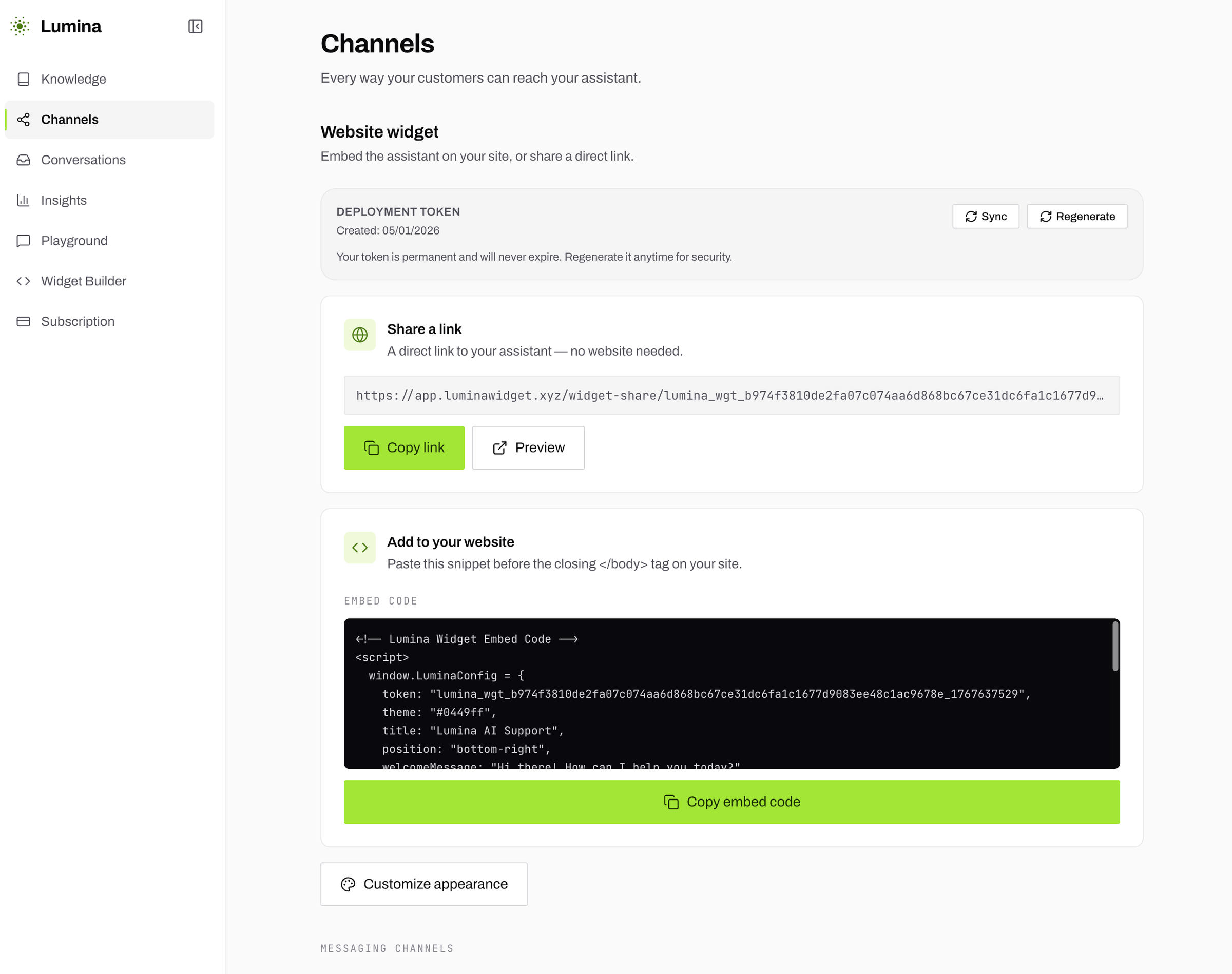
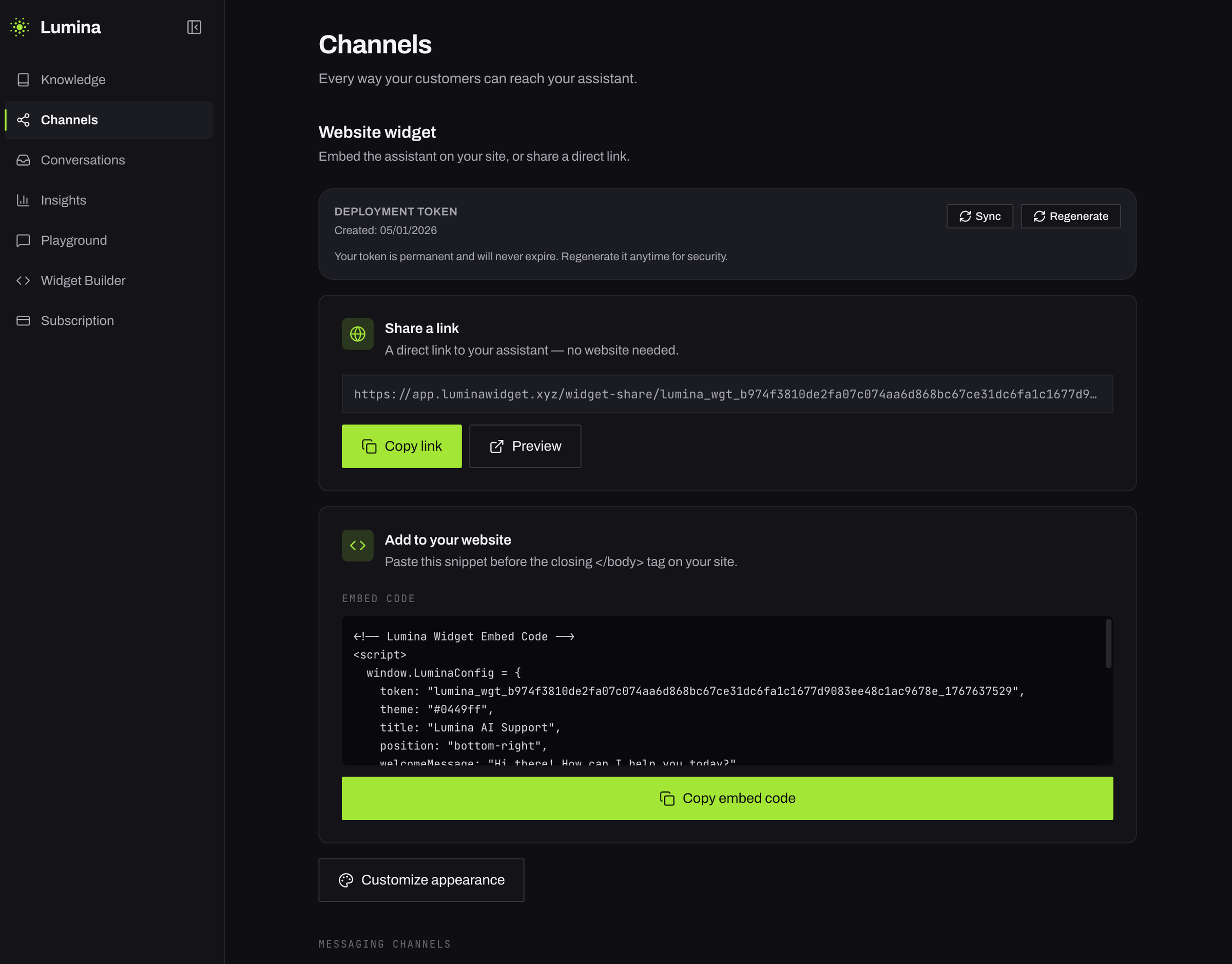
Channels — app.luminawidget.xyz
Four capabilities, one agent.
The whole corpus, every question.
No chunking, no embeddings, no retrieval step. Your entire knowledge base enters the context window on every request.
A human, whenever you want one.
Every conversation across every channel lands in one place. Take over any thread, reply on the same channel, hand it back to the agent.
Conversations →One brain, every channel.
Website, share link, Telegram direct chats and groups, Discord servers. Same knowledge, same persona, same answers. Connect in minutes.
Live availability, not guesswork.
Connect Google Calendar and the agent answers scheduling questions from your real diary. It never sees event titles, guests or notes.
Calendar availability →No chunks. No retrieval. No guessing.
Most AI assistants index your documents, split them into fragments, and pull back a handful per question. What the search misses, the model never sees — and a model that has seen only fragments will confidently fill the gaps.
Lumina takes the other path. Your entire knowledge base is injected into a one-million-token context window on every single request. The agent is not recalling your documents. It is reading them.
A support bot can afford to be wrong. A bot quoting your loan terms, your dosage guidance or your cancellation policy cannot.
Stated precisely — what caching means for your data
Caching means short-lived retention of prompt content by the model provider. On Vertex AI that retention stays inside the chosen geography — the EU. It is not "no retention at all", and a client asking the question deserves the precise answer rather than a marketing sentence.
And when it can't, a person is told.
There are two things a knowledge agent must never do: guess, and quietly absorb a request it has no standing to answer. Someone asking for a human, or asking you to erase their data, is not a question — it is an obligation with your name on it.
Taking a conversation over answers I want a person. It does not answer delete my data — only deleting it does, and nothing is ever erased automatically. A flag is raised; a person decides. None of this is configurable, on any account, including by us.
And when it simply doesn't know — the three hard stops
A system that would rather say nothing than guess.
Your knowledge on top. European infrastructure below.
Where it runs, on a map


Four moving parts. Since 29 July 2026, every one of them runs inside the European Union.
Wherever the question gets asked.
Prepare your knowledge once. Every channel draws on the same agent, and every conversation returns to the same inbox.
How it connects
Where the same agent answers. One brain, and every conversation returns to the same inbox.
In the language it was asked in.
Lumina answers in the majority of world languages, including every European one. Set one default language, or let the agent match each customer.
Match the customer
Your agent replies in whatever language each customer writes in, on every channel.
Always one language
Pick one in Agent Config and every answer comes back in it, whoever asks.
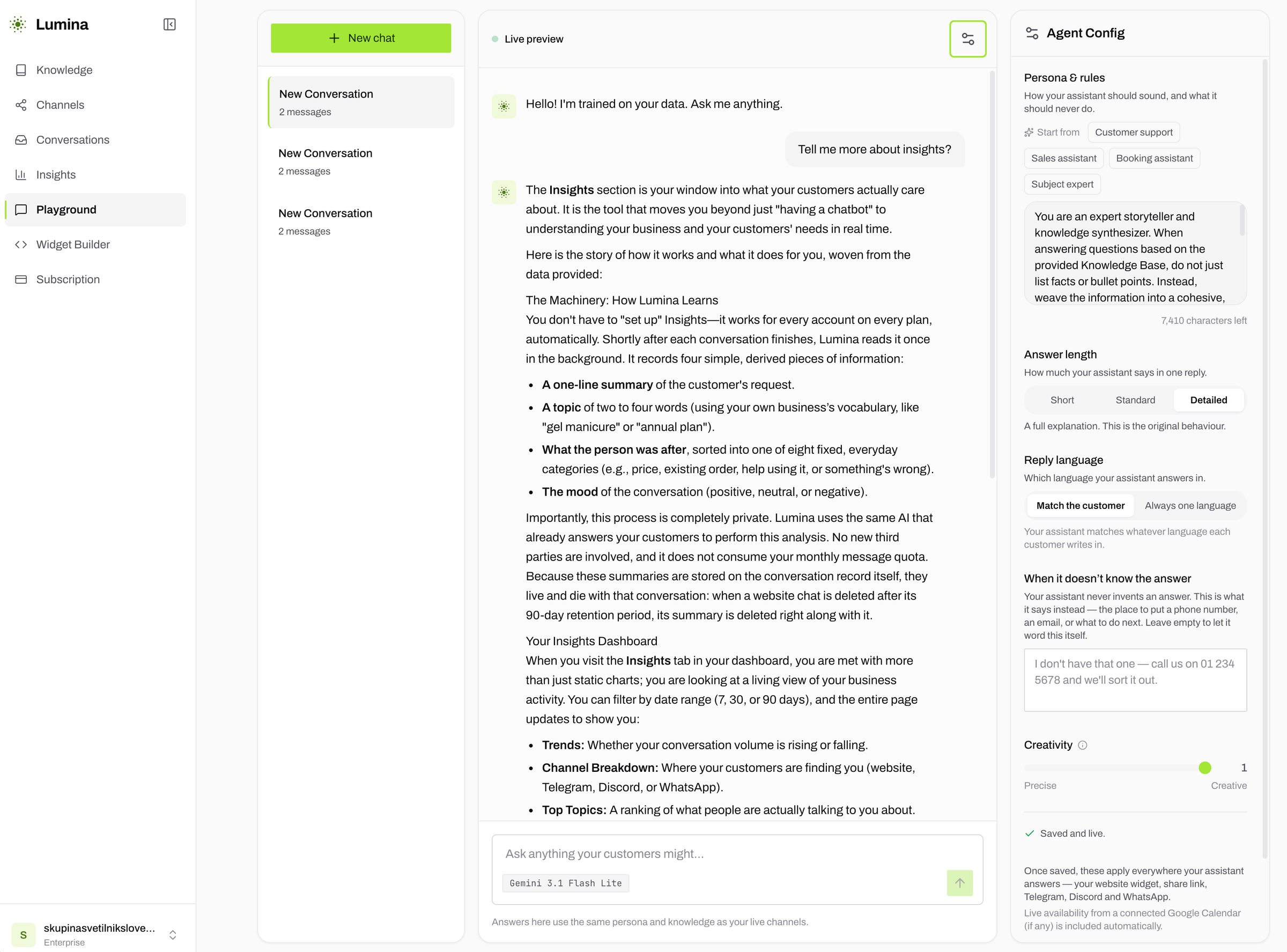
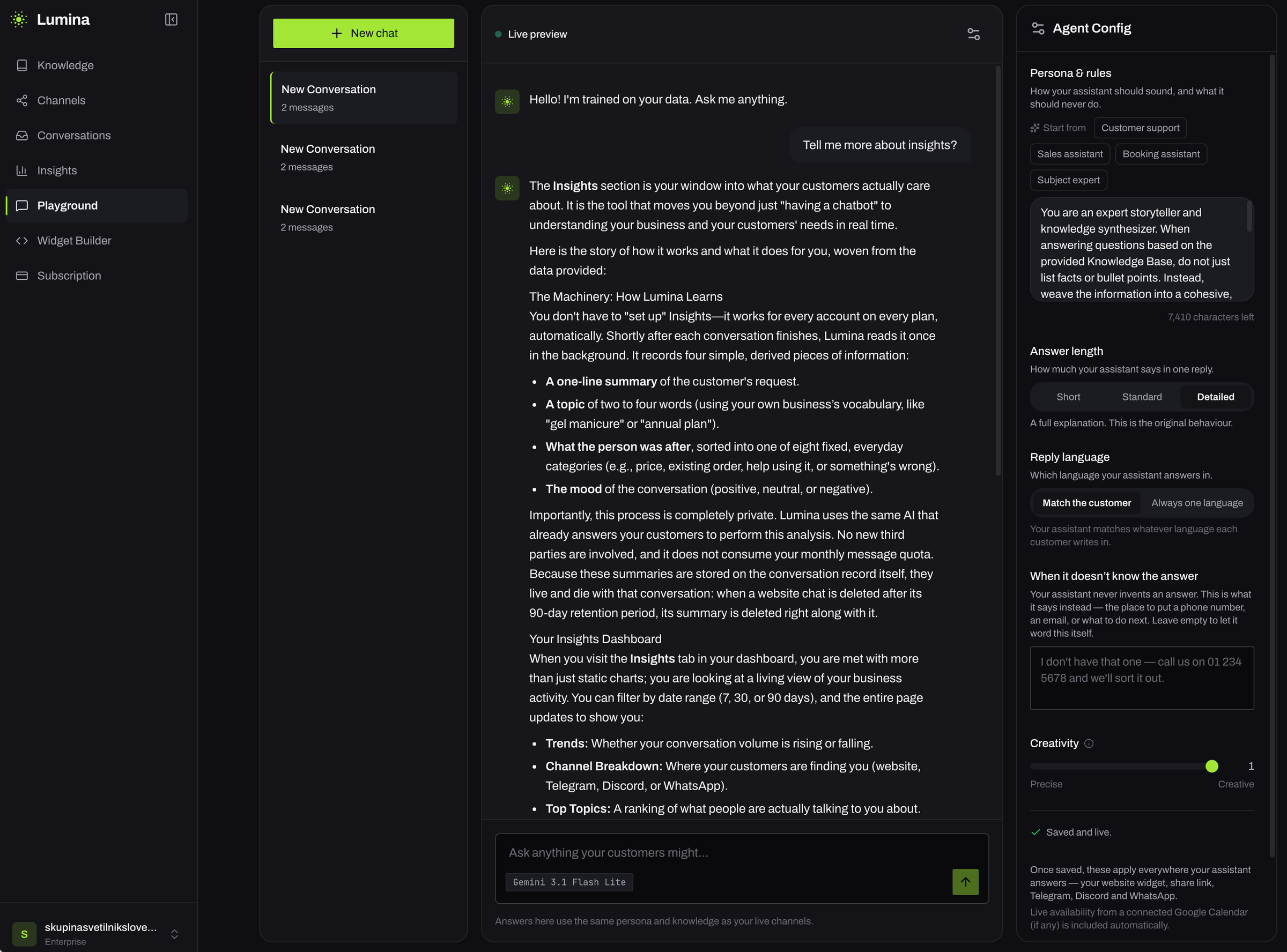
Reply language sits in Agent Config, beside persona, answer length and the fallback line
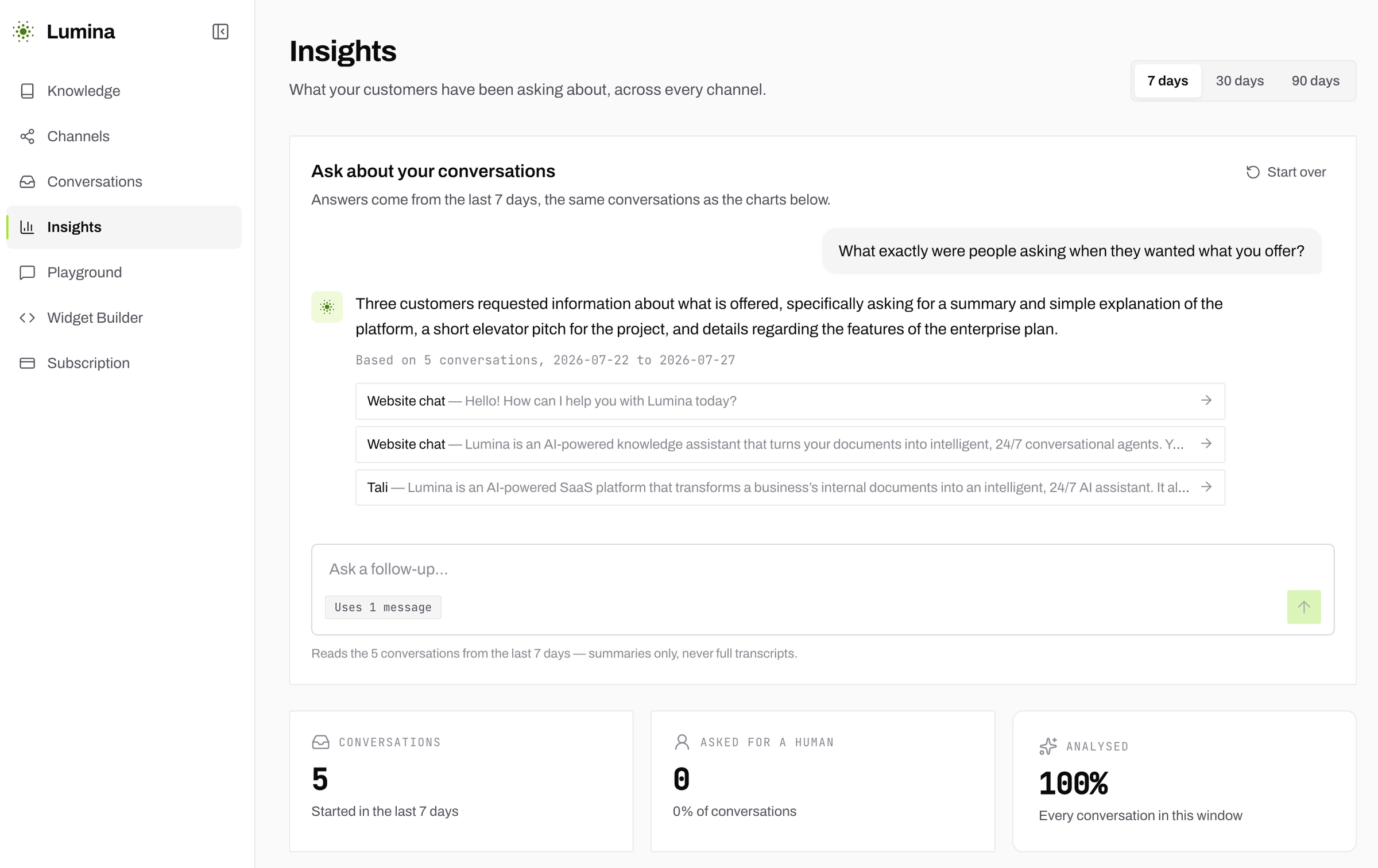
Shaping how it talksAsk your conversations a question.
Conversations answers where is that one chat? Insights answers what are my customers asking about? — over 7, 30 or 90 days, in your own vocabulary, from conversations Lumina already read as they arrived.
It always says what it looked at.
Every answer carries its basis — based on 312 conversations, 1–27 Jul — and the conversations it read, each one clickable. You cannot tell "nobody complained" from "it only read nine of them".
Every number is a door.
"23 people asked about price" — click it, and there are the 23 conversations, same dates, filter shown as a chip. The address bar updates, so a view you check weekly can be bookmarked or sent on.
Two flags you can count.
Asked for a person and asked for their data are separate badges with separate filters. One is a staffing signal. The other is a legal one with a deadline — and when your DPO asks how many you had last quarter, you can answer.
Worth adding to your knowledge base.
The topics where customers most often ended up asking for a person — with a button straight into Knowledge. Analytics, then a better agent, then fewer people needing you.
It reads the short summaries, never your customers' full chats.
How Insights worksA hairdresser and a bank have the same problem.
Both answer the same questions all day. Both lose customers to the ones they answer too late. The stakes differ; the mechanics don't.
Service businesses
Salons, clinics, restaurants, hotels, studios.
Your hours, prices, policies and real availability — answered at eleven at night, without you.
Product & community teams
Software, crypto, digital products.
The same forty questions in Telegram and Discord, every week. The agent takes them. You get your evenings back.
Regulated & enterprise
Banks, insurers, legal, pharmacy, real estate, education.
Where a wrong answer is not an inconvenience. It's a liability with your name on it.
European by architecture, not by badge.
Encryption, tenant isolation, secrets handling and abuse containment are documented in full on our security page — including what we haven't certified.
Your documents and every conversation are stored in the European Union, in Google Firestore's eur3 multi-region. Every backend request is processed in the European Union, in europe-west1, Belgium.
Since 29 July 2026, so does every AI inference call — on Vertex AI's eu multi-region endpoint. The reply your customer reads, the summary on your Insights screen, the answers to your own questions about your own conversations, even counting the tokens in a document you upload. The model did not change; its geography did. No inference call remains outside the European Union.
What we do not claim
That Lumina is "fully GDPR compliant" or "EU AI Act certified". Neither phrase means anything on its own, and compliance is a property of your deployment as much as of our code.
That our legal texts have been through counsel. The Data Processing Agreement is a draft, tailored per client, awaiting review — and it says so on its face.
That EU residency settles every transfer question. It settles the largest one. Payments, email delivery and whichever messaging platforms you choose to connect are separate, and are still being worked through.
That everything about one person can be erased on the website channel. A widget conversation lives in one browser tab and nothing follows a visitor between visits — so there is no profile to assemble and no "this person" to look up. Any conversation you can identify, we delete.
We are not lawyers, and we don't publish legal conclusions. We publish the architecture, in detail, and let your Data Protection Officer draw their own.
Read the compliance packThe software is the easy part.
Uploading documents takes minutes. Writing documents an agent can answer from — clean, structured, complete, in your voice — is the actual work. Most projects fail there, quietly, and blame the model.
So we do it with you.
Lumina orientation
Thirty minutes. What you know, where your customers ask, what a good answer looks like — and whether you want to build it yourself or have us do it. Book it →
Knowledge onboarding
We shape your material into the corpus your agent will read, tune its persona and language, and test it against the questions you actually get. Knowledge →
Go live, everywhere
Website, Telegram, Discord, calendar. One agent, connected to every channel you use, with your inbox behind it.
Invoiced monthly against actual usage, under an agreement written with you. Self-serve subscriptions open later — deliberately, in that order. What counts as a message →
Book a callWorking notes.
We write about what we ship, including the parts that didn't work. Two pieces cover Generation 2 — the enterprise-grade, compliance-first, EU-resident product this page describes. Start with the essay; the paper is there when you want the evidence underneath it.
Ask the agent. Or ask the founder.
@lumina_community is staffed by the Lumina agent — running on Lumina's own documentation — and by the team that built it. All answer.